



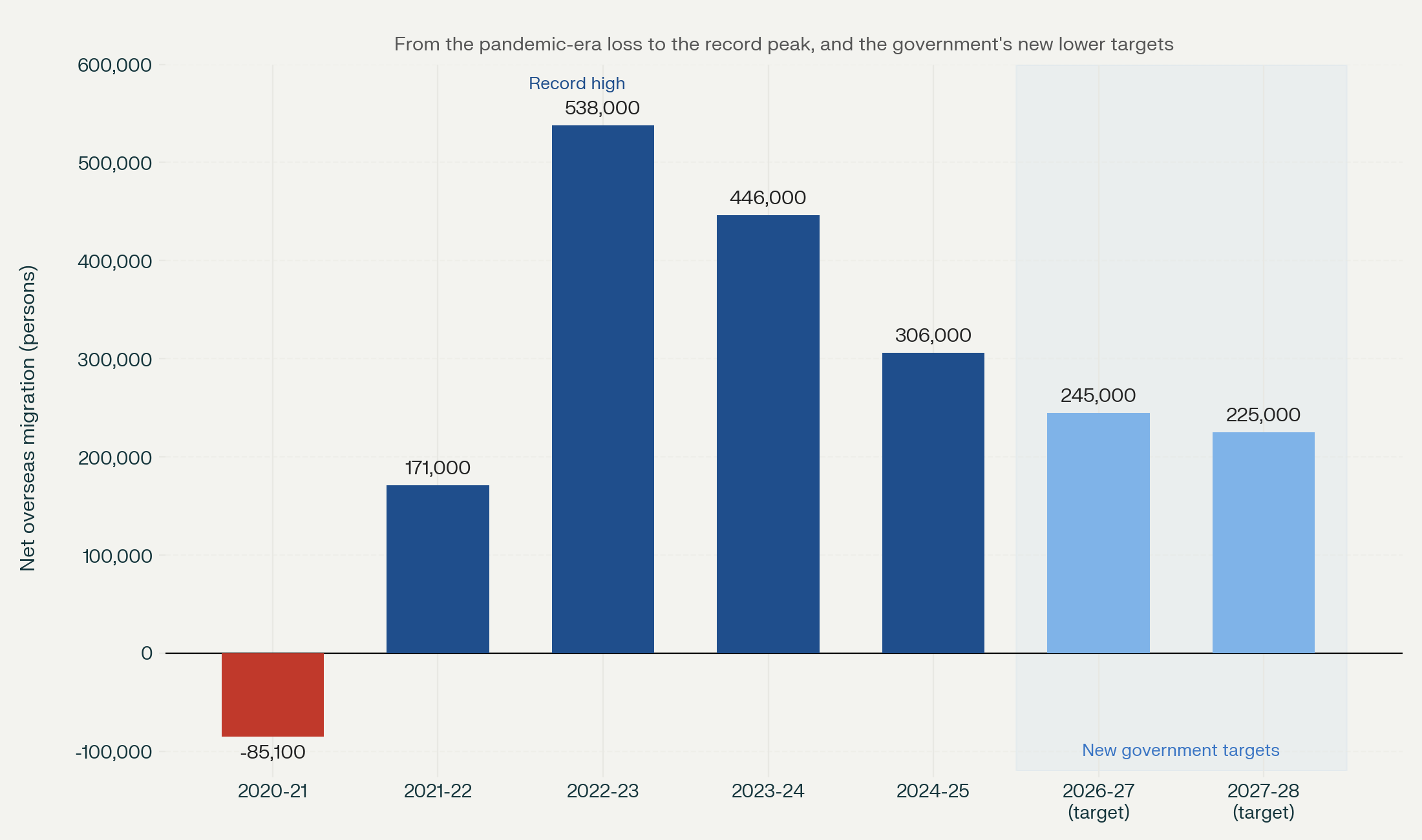
Home Affairs Minister Tony Burke has told the country the government’s migration forecasts are no longer forecasts. They’re targets, 245,000 net overseas migration this financial year and 225,000 the next, and he’s tying them explicitly to the price of housing.
Burke unveiled the detail at the National Press Club on Thursday, in a speech titled “The Work of Managing the Migration Program: Who Arrives, Who Stays, Who Leaves.” It had been delayed six weeks amid reported disagreement inside cabinet.
It arrives as a package of regulatory changes rather than legislation. Compromise talks between Prime Minister Anthony Albanese and Opposition Leader Angus Taylor broke down last week over a list of Coalition demands, including tougher rules linked to ISIS-connected partners and a push to tie migration numbers to housing completions.
What changes
International students will no longer be able to bring family members on most visas, with carve-outs for students from Pacific and ASEAN countries and some postgraduate courses. Working holiday makers move onto a ballot system: second-year places capped at 45,000, third-year places cut from 31,000 to 5,000.
Visa processing is re-prioritised toward construction, health, agriculture, fisheries and teaching, after sustained complaints from those sectors about being outpaced by other visa categories. Migration agents who encourage “non-meritorious” claims face sanctions or deregistration.
A hundred additional compliance officers and 250 extra detention beds are earmarked for pursuing visa overstayers. The skilled-migration points test is redesigned to weight a trade qualification the same as a university degree.
Burke also flagged two further changes he wants but currently can’t deliver without Parliament: a cap on international student arrivals through an expression-of-interest mechanism, and tighter rules on protection-visa claims from countries where the refusal rate already exceeds 85 per cent.
The same day, the Australian Bureau of Statistics released its own population data, showing net overseas migration had already fallen to 292,100 in the year to March, the lowest reading since mid-2022, and below the 309,500 recorded the year before. Migration was easing before Burke’s speech. The new targets are designed to keep pushing it down further and faster, from a base that peaked at a record 538,000 in 2022-23 after the pandemic-era net loss of 85,100 people in 2020-21.
The word doing the work
The shift from forecast to target matters more than it might read at first pass. A forecast is a prediction a government can revise without much political cost. A target is something a minister is accountable for delivering. If net overseas migration lands above 245,000 this year, that’s now a policy failure rather than an external shock: Burke’s own number, on his own record. Setting a hard number this way suggests the political cost of leaving migration levels open-ended has come to outweigh the risk of missing a stated target, which says something about how central housing pressure has become inside cabinet’s calculations.
Appreciate the newsletter but aren’t ready to pay for a subscription? Grab us a beer or snag the exclusive ad spot at the top of next week's newsletter.
Who says they’ll pay for it
Burke didn’t dress the changes up as cost-free. Asked about the economic flow-on, he said he “can’t quarantine any sector” of the economy from the impact. The National Farmers’ Federation took him up on it directly, warning that cutting backpacker numbers will hit the workforce that picks and packs Australian produce. Its chief executive put the consequence in plain terms: “We will see a lift in the price of food. We will see emptier supermarkets.”
The criticism isn’t confined to industry. One Nation leader Pauline Hanson has spent months campaigning for deeper migration cuts than Labor has proposed, yet her own plan, unveiled just days before Burke’s speech, didn’t go as far on backpacker visas as what he has now announced. That detail complicates a simple reading of the changes as Labor chasing One Nation’s base.
Neither the Coalition, reportedly circling a target of 150,000 to 170,000, nor One Nation, which wants net-negative migration through a 750,000-visa cut over three years, has locked in a final position. Both proposed levels sit below Burke’s own targets. That puts the coming argument over how far and how fast to cut, not whether cutting is warranted at all. Every major party now agrees on that much.
Why it matters
Migration policy has become inseparable from housing policy in this government’s own framing, and Thursday’s speech is the clearest statement yet of that link. It’s also a reminder that regulatory action doesn’t only run in one direction. The industries built around the settings Burke just changed (international education, horticulture, tourism, the migration advice sector) now have to adjust to a policy shift made by ministerial regulation rather than negotiated legislation, with no parliamentary vote to contest it directly.
The next test comes from the Reserve Bank, which hands down its next interest rate decision on 29 September with this announcement squarely in the background, and from the Coalition and One Nation, both expected to firm up their own competing migration numbers now that Labor has moved first.
Follow us on all major podcasting platforms and social media channels for important updates. Your support keeps independent journalism alive!For more in-depth coverage on these stories and other news affecting Australia and the world, subscribe to readmencari.com. Support our independent journalism by listening to our podcasts on all major platforms and considering a subscription to help us continue delivering fearless reporting free from financial and political influence.

As well as knowing you’re keeping MENCARI alive, you’ll also get:
Get breaking news AS IT HAPPENS – Gain instant access to our real-time coverage and analysis when major stories break, keeping you ahead of the curve
Unlock our COMPLETE content library – Enjoy unlimited access to every newsletter, podcast episode, and exclusive archive—all seamlessly available in your favourite podcast apps.
Join the conversation that matters – Be part of our vibrant community with full commenting privileges on all content, directly supporting Mencari's
Stay with readmencari.com for continuous updates on these developing stories and more from across Australia, New Zealand, and the globe. Subscribe to our newsletter for daily briefings delivered straight to your inbox!
Got a News Tip?
Contact our editor via Proton Mail encrypted, X Direct Message, LinkedIn, or email. You can securely message him on Signal by using his username, Miko Santos.
🛑 More on Kangaroofern Media Lab
Read our last AU Politics newsletter : Bendigo Bank Axes 158 Roles
Read our last AI newsletter : Anthropic Raises $13B Series F
Read our last Tech newsletter : Australian Court Rules Apple
Read our last Podcast newsletter : Spanish podcast listeners seek more Latino cultural content:YouTube Unveils AI Podcasting Tools


